

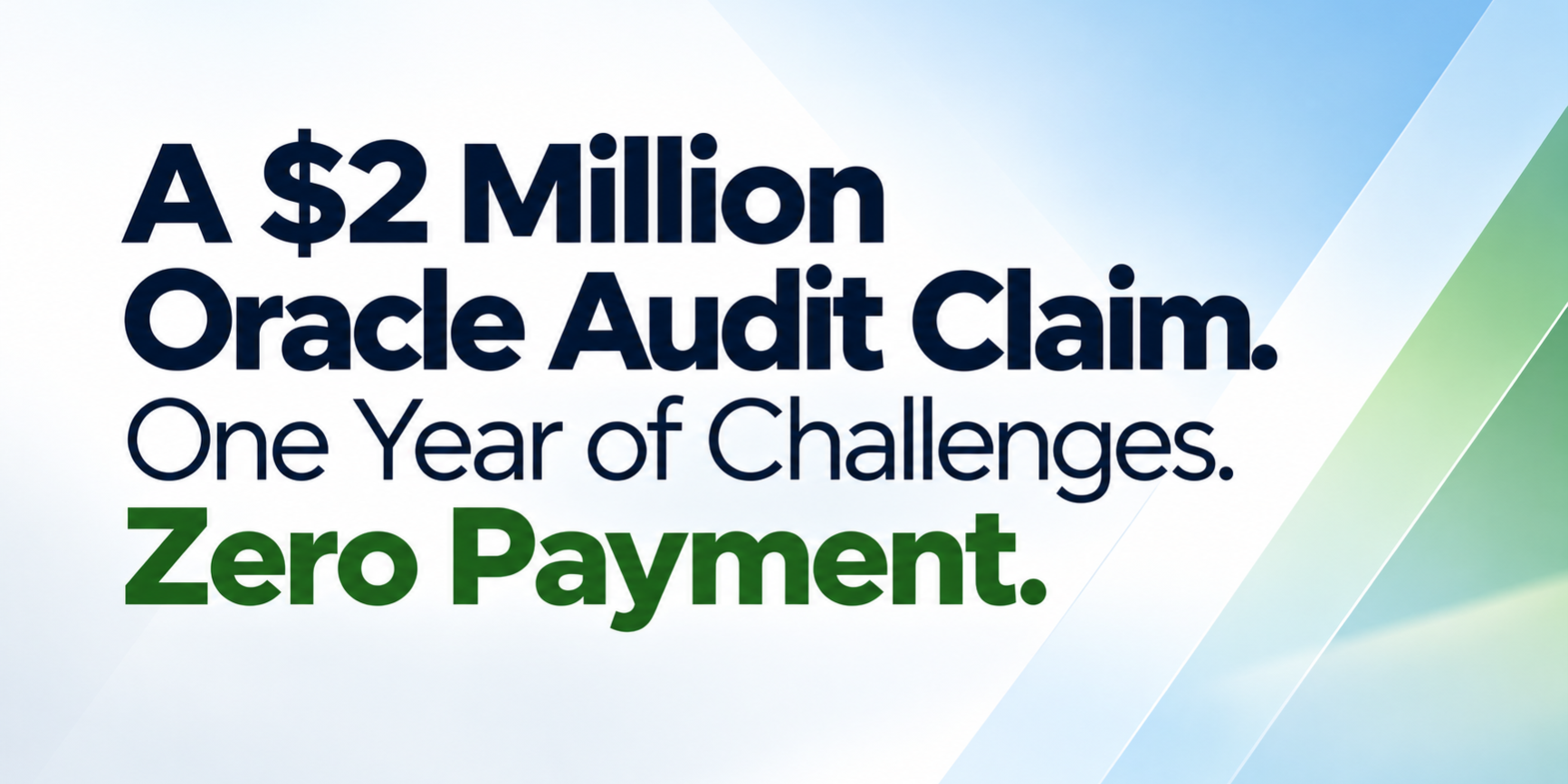
Oracle’s Own Licensing Mistake Led to a $2 Million Audit Claim. The Client Paid Nothing.
An organization was facing an Oracle audit claim exceeding $2 million. Oracle’s licensing team had completed its assessment, calculated the alleged financial exposure, and delivered its findings.
Then Oracle’s sales team stepped in. Suddenly, the tone changed. Oracle understood the situation. They wanted to help. As a gesture of goodwill, they were prepared to take hundreds of thousands of dollars off the claim.
It felt like a familiar good cop, bad cop routine. The message was clear: let’s sit down, talk numbers, and see if we can make a deal. With such a substantial discount already on the table, it was tempting to engage. If Oracle was willing to concede that much before negotiations had even begun, perhaps an experienced negotiator could secure an even better deal.
But something didn’t add up. The organization wasn’t necessarily disputing every finding. It simply felt the claim was far too high. It had already questioned Oracle’s position but lacked the specialist licensing knowledge and audit experience to pinpoint the weaknesses.
They could negotiate a bigger discount. But would that mean they were getting a fair deal? That’s when they contacted License Consulting.
Looking Beyond the Audit Findings
We started by examining Oracle’s audit findings and the discussions that had already taken place. One finding caught our attention. Oracle claimed that customizing a product the organization had already licensed required licenses for a second product, which it did not have.
And Oracle was right. Those additional licenses were required. But before accepting the financial consequences, we wanted to understand how our client had ended up in that situation.
Who had decided which licenses to purchase? Had our client selected them, or relied on the supplier to specify what was needed? We went back to the original purchase records, proposals, and correspondence. And that’s where the story took an interesting turn.
Approximately ten years earlier, our client had issued a competitive tender. But it wasn’t a tender for Oracle licenses. The organization wanted a working business solution. It had described what that solution needed to do and invited suppliers to explain how they would deliver it, and at what price.
Oracle participated alongside SAP and other vendors. Working with a partner, Oracle proposed a solution and specified the software and licenses to support it. Oracle won the tender. The organization accepted the proposal, paid the agreed price, and implemented the solution.
Ten years later, Oracle was claiming that additional licenses had been required all along. Yet those licenses had never appeared in the original offer. That changed the nature of the discussion.
Our client hadn’t set out to buy a particular collection of licenses. The licenses were simply a means of delivering the business solution it had requested. The objective was the solution itself, with its agreed functionality and price. It was Oracle and its partner who had proposed how to deliver that solution, including the licensing they believed was necessary.
And there was another question. Had the missing licenses been included, Oracle’s bid would have been more expensive. Would Oracle still have won? Or might the organization have chosen SAP or another supplier? We could not establish why the licenses were omitted, or whether the tender outcome would have been different. But the original documentation showed that our client had relied on Oracle and its partner to specify what was required, and had paid the price they proposed.
Why should our client now be expected to pay extra for something that should have been included from the beginning?
Oracle’s technical finding was correct. The additional licenses were required. Whether the resulting financial claim was justified was an entirely different matter.
The Long Conversation
Armed with the original procurement evidence, we challenged Oracle’s position on the missing licenses. And that was only one part of the defense: We examined the other audit findings, challenged licensing interpretations, and questioned the contractual basis for Oracle’s demands. Several findings were successfully challenged, substantially reducing the remaining exposure.
License Consulting developed the strategy, analyzed Oracle’s responses, and prepared the arguments and correspondence used to challenge the claim.
Oracle continued to propose commercial settlements. We continued to question the substance of the claim. The correspondence went back and forth for almost a year. Over that time, Oracle had opportunities to explain and substantiate the disputed positions, but important questions remained unresolved.
Eventually, the remaining exposure looked manageable. Our client was comfortable considering a reasonable settlement within its budget. And there was a practical reason to do so: the organization still needed a working relationship with Oracle long after our engagement ended. For our client, this was never about winning an argument at any cost. It was about resolving the matter on reasonable terms and moving forward.
Then, before any settlement was agreed, Oracle sent its final letter. The audit was closed.
No settlement agreement. No payment. No legal proceedings. Oracle did not acknowledge that its findings were incorrect. Nor did it formally confirm that our client was compliant. Oracle simply stopped pursuing the claim.
If Oracle believed its multimillion-dollar claim was fully justified and recoverable, why did it choose not to pursue it?
We cannot know what led Oracle to that decision. The closure was not a legal ruling, and it did not erase the underlying findings. But it was a significant outcome: after almost a year of challenges, Oracle chose to close the audit without recovering any payment. Our client also retained the full record of the correspondence, the original tender documents, and the arguments Oracle had been asked to address. If the same issues ever resurface, the organization will not be starting from scratch. It can point to the history of the dispute, the evidence presented, and Oracle’s decision to close the audit without pursuing the claim further.
Before You Negotiate
Our client could have taken a very different route: Oracle had offered substantial discounts before License Consulting became involved. A negotiated settlement might have looked like a commercial success. But a discount tells you how much less Oracle is prepared to accept. It does not tell you how much of the original claim was justified.
Investigating a claim fundamentally changes the position. It gave our client the evidence, arguments, and confidence to make an informed commercial decision. Not every Oracle audit claim can be eliminated. Sometimes a form of settlement is part of the outcome. But that settlement should follow a clear understanding of the facts, the contracts, and the strength of Oracle’s position.
Oracle deals with Oracle licensing, audits, and commercial negotiations every day. Most organizations don’t. At License Consulting, we help level that playing field.
The greatest reduction in an Oracle audit claim does not come from negotiating a better discount: It comes from challenging the claim itself.
Facing an Oracle Audit Claim?
Before entering settlement negotiations, find out what Oracle can actually substantiate. Learn more about our Oracle Audit Claim Reduction service.