

Oracle Cost Reduction: Look Beyond the Discount
When organisations look to reduce their Oracle costs, attention often turns to the most visible number: the price. Can we negotiate a better discount? Can we reduce the renewal increase? Can procurement get a better commercial offer?
These are valid questions. But focusing on price alone can mean overlooking other significant cost reduction opportunities.
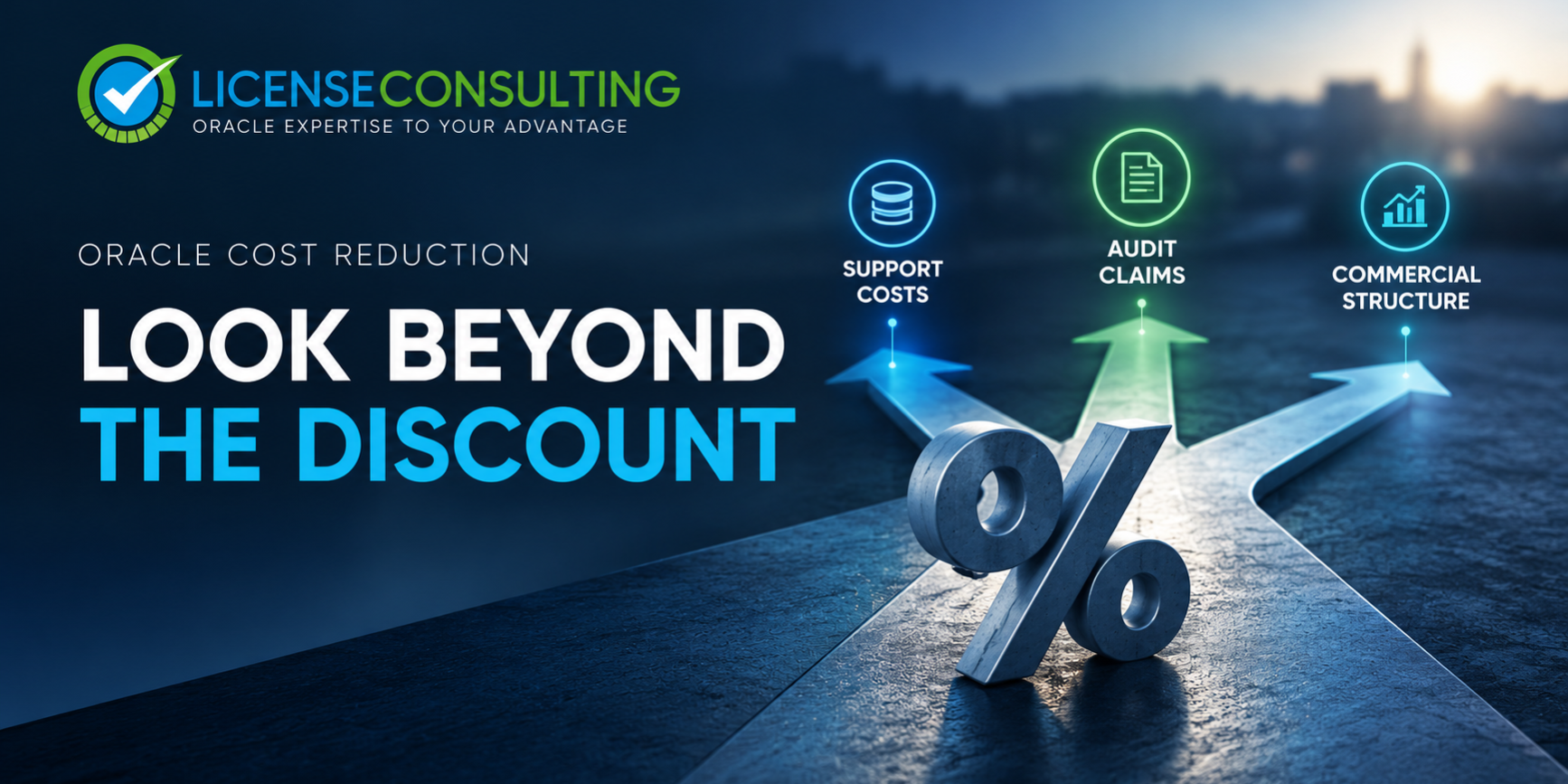
Oracle cost reduction requires a broader view: understanding what you are paying for, why you are paying for it, and whether the commercial structure still reflects what the organisation actually needs. That means looking beyond the discount.
Three areas where Oracle costs can be reduced
1. Reduce recurring Oracle support costs
Many organisations know they are paying annual Oracle support for licenses they no longer use or need. Some have even tried to reduce that cost before.
They terminated unused licenses, expecting their annual support bill to fall accordingly, only to encounter Oracle’s repricing rules. The remaining licenses were repriced, often eliminating the expected saving entirely. In some cases, the recalculated support fee can even exceed what the customer was paying before, with Oracle then maintaining the existing fee rather than increasing it. The result: the customer pays the same annual support cost, but for fewer licenses.
After experiencing that once, it is understandable to conclude that reducing Oracle support costs simply isn’t possible.
But in many cases, it is. The key is not simply identifying licenses that can be terminated. It is understanding Oracle’s support policies, contractual structure and repricing mechanisms before making the change, and determining which route can actually produce a sustainable reduction.
There is also another approach frequently presented as Oracle support cost reduction: moving away from Oracle support altogether and using a third-party support provider, such as Rimini Street or Spinnaker Support. That can significantly reduce annual support expenditure, but it is a fundamentally different decision.
For some organisations, particularly in regulated environments or where OEM support is required, third-party support may not be a viable option. For others, it can be, but the wider consequences need to be considered before making the move.
So there are effectively two different routes to reducing Oracle support costs.
Can we reduce what we pay Oracle while remaining on Oracle support? In many cases, yes. The key is to understand Oracle’s support policies, contractual structure and repricing mechanisms before making any changes. Simply terminating unused licenses can trigger repricing and eliminate the expected saving. Structured correctly, however, substantial and sustainable reductions can be achieved while maintaining Oracle support.
Explore Oracle Support Cost Reduction →
Can we reduce costs by leaving Oracle support? Yes. Moving to a third-party support provider can significantly reduce annual support costs. But before making that move, it is important to understand your Oracle license position.
The possibility of increased licensing scrutiny following a move away from Oracle support is a well-known concern in the market. Whether or not an audit follows, an organisation considering third-party support should assume that its Oracle license position may be examined and prepare accordingly.
An internal Oracle license audit before terminating support allows potential compliance issues to be identified and remediated on your own timeline. Otherwise, part of the support saving can quickly be outweighed by an unexpected licensing claim.
Oracle Internal License Audit →
If an Oracle audit has already started, the situation changes. You are working against Oracle’s process and timelines, and potential compliance issues can quickly become commercial exposure.
2. Reduce Oracle audit claims before negotiating them
A second cost-reduction opportunity arises when Oracle presents a compliance claim following an audit. At that point, many organisations immediately move into negotiation mode. If Oracle presents a $2 million claim, the discussion becomes: How far can we negotiate the $2 million down?
But that assumes the $2 million is the correct starting point. Before negotiating the amount, the underlying technical findings, contractual interpretations, licensing assumptions and calculations should be challenged.
A deployment identified by Oracle does not automatically equal a valid licensing requirement. And a licensing requirement does not automatically justify the commercial value Oracle attaches to it.
The difference between a $2 million claim and a $500,000 position may have less to do with negotiation than with how the underlying licensing position is interpreted.
Explore Oracle Audit Claim Reduction →
3. Optimize the structure before negotiating the price
The third area is broader and potentially more important. When organisations negotiate a new Oracle agreement, renewal, ULA or other commercial arrangement, considerable effort is often spent on achieving the best possible discount. But a large discount does not automatically make a good deal.
A 60% discount on the wrong licensing structure can be considerably more expensive over five years than a 40% discount on the right one.
Before negotiating price, organisations should therefore understand what they actually need, how requirements may change, what flexibility they are giving up and what the agreement could mean for future support, growth, cloud adoption, divestments or changes in infrastructure. Only then does negotiating the discount make sense.
Our role is not to replace your procurement team. We make sure they’re negotiating the right deal.
Explore Oracle Cost Optimization →
Cost reduction starts before the negotiation
These three situations are very different, but they have one thing in common: the largest saving is often created before the commercial negotiation starts.
It comes from changing the position from which you negotiate:
- reducing the underlying support cost before negotiating annual increases;
- challenging the validity of an audit claim before negotiating a settlement;
- determining the right commercial structure before negotiating the discount.
Price remains critically important. Achieving the best possible commercial terms is an essential part of any Oracle negotiation. But equal attention should be given to the position you are negotiating from. Significant savings can be lost before price is ever discussed.
Are you paying the right price for the right thing?